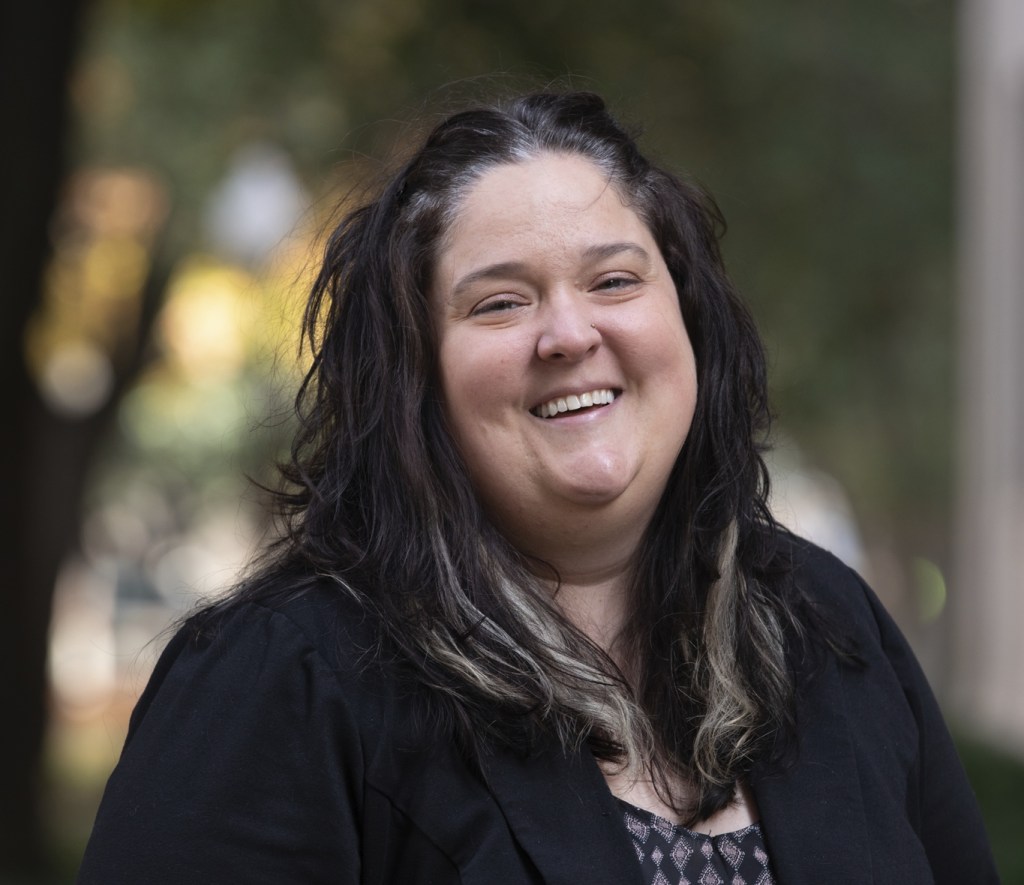
Hello! I’m Sarah Shelton, a writer, teacher, and scholar living in Arlington, TX. Here you’ll find information about the different aspects of my work and this website.
Current Projects & Teaching
Publications & Presentations
- Editor of a forthcoming student-authored essay collection on identity, developed in Advanced Exposition and published through UTA Library’s OER program, Summer 2025.
- Editor and organizer of an OER edited collection featuring UTA faculty chapters on using experiential learning in UTA courses across disciplines. Supported by a $5,000 UTA Libraries Open Initiatives Grant, Fall 2025.
- A virtual talk (SWPACA Summer 2025) and article on teaching a course on AI in Fiction where students critically examined AI narratives from myth to contemporary pop culture and imagined alternative technological futures. Drawn from classroom experience and student engagement.
Research & Professional Development
- How project development frameworks like Agile and Scrum and tools like Trello can support collaborative learning in classrooms and internship mentoring. I’m especially interested in how these models enhance organization, autonomy, and digital fluency in humanities education.
- How the curriculum designed for ENGL 3391 is (or isn’t) helping majors/minors gain confidence in their degree choice and strengthen their understanding of the skills they’re developing in the program. I’m currently developing an IRB protocol for surveys, reflection work, and interviews of past and current students to better assess the course and its learning outcomes.
- How neurodiversity—especially ADHD—shapes the writing process and how writing instruction can better support diverse cognitive approaches. I’m especially interested in strategies that promote focus, flexibility, and metacognitive awareness in neurodivergent learners.
Spring 2025 Courses

Study and sharpen your writing process through focus on audience, style, and revision.

Examine how stories both reinforce and resist disability stereotypes, shaping powerful narratives about identity, difference, and societal norms.
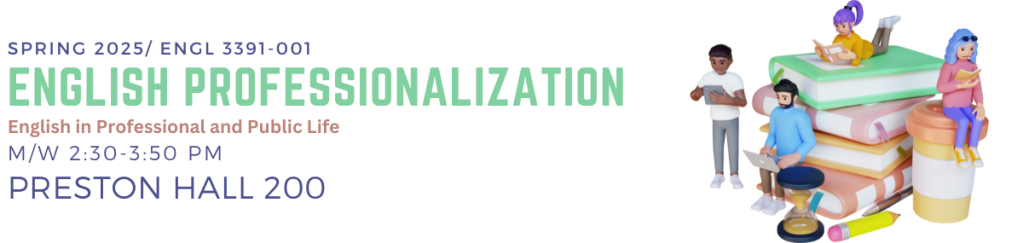
EPPL introduces students to real-world applications of English Studies through career exploration, professional writing, and hands-on development of public profiles.
Summer 2025 Course
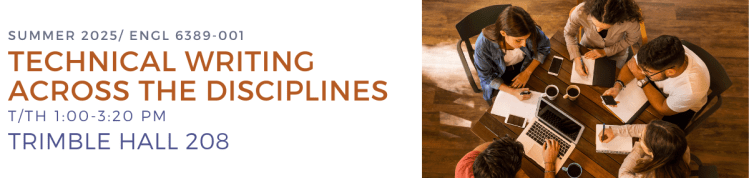
Designed especially for graduate writers, TWAD emphasizes writing as process and clear, purposeful communication for professional success.
Blog
On the blog, I share and publish words from all the areas of my life, both creative and scholarly. If, as I argue, writing and reading are onto-epistemological acts–ways of knowing-in-being–then I plan to be here as much as possible. As a teacher who believes that pedagogy, research, and theory are all inextricably entangled with our larger lives, I also share posts/stories about teaching. Part of a productive posthuman pedagogy–which I am continually working on–is the sharing of successes and failures with applying posthuman frameworks, strategies, and theories to the everyday classroom.
Since I let all my interests and work mix on the blog, use the following category tags to see posts just about pedagogy or my academic work:
- Academia
- Agential Realism
- Calibrate
- Classroom
- Curate
- Diffraction
- Dissertating
- Elsewhere
- Material
- Pedagogical Documentation
- Spacetimemattering
- Teaching
- Conference
- Excerpts
- Presentation
- Published
- Research
- Scholarly Musings
- Talk
- Writing Is
- Writing Through All the Things
Dissertation
“Teaching Elsewhere: Curating↔Calibrating Posthumanist Possibilities”
Successfully defended August 22, 2018
Diffracting fiction and the case studies of two sophomore-level literature courses through feminist posthumanisms (particularly agential realism, material feminism, feminist poststructuralist inquiry, and post-qualitative inquiry), I argue that college professors can, immediately and locally, materialize different possibilities for our students’ knowing-in-being than the ones a traditional humanist education system imposes on us. A form of teaching↔as↔inquiry through pedagogical documentation and diffraction, “teaching elsewhere” uses curation↔calibration as an apparatus that both proliferates (diffracts) the posthumanist possibilities in a classroom and also holds us responsible for and accountable to each unique, unrepeatable classroom we teach-with. Through curating—texts, objects, people, places, concepts, experiences, activities, artifacts, etc.—with the classroom (from the whole phenomenon) instead of pre-planning everything ourselves, we can calibrate for more posthumanist possibilities (i.e. those that take into account the contribution of all actants in the meaning a classroom makes together). We curate to calibrate and calibrate through curation; they are inseparable and require intentional and sustained observation to notice the dynamic flows of agency throughout all actants—human and nonhuman alike—in the classroom-as-phenomenon. Not a particular curriculum or pedagogy, teaching elsewhere is, more critically, about a teacher’s deliberate shift in thinking about the classroom (from inert imposition to agential phenomenon) and about the posthumanist praxis she develops to deliver any curriculum. In changing how she views both the classroom and how it produces meaning—not as simply an epistemological concern (human interaction) but as an onto-epistemological doing (the world’s intra-action)—she can create the opportunity (elsewhere) for students to learn as they live: entangled with the world in a continual and emergent becoming-with.
Past Research
PH Praxis (Digital Project)
A digital archive and resource hub for posthumanist pedagogy and research into teaching during the COVID-19 event. From the site:
This website is a cybernetic extension of two human researchers: Sarah Shelton and Miriam Rowntree. The function of this extension is to be a repository for posthuman praxis, both its theory and its implementation. Contributors vary from social media agents to other human researchers to the classrooms, desks, and blackboards that shape such pedagogical research. In engaging with various media, we (the humans and the technology) provide a platform for teaching narratives to shift and for posthuman praxis to become a more integral part of our pedagogical identities.
Though my research partner and I are not currently actively updating the archive, it remains as a digital artifact of our work and life during COVID and the immediate years after.
Creative Work
I’ve also published two short stories under the name Alice Edward in horror and fantasy magazines.
 Sarah A. Shelton, Ph.D.